This article examines whether childfree people regret their decision, highlighting that research consistently shows most intentionally childfree adults do not regret their choice, even if a small minority experience occasional longing.

There is a cultural script that follows childfree adults like background noise:
“You’ll regret it.”
It is rarely shouted. More often, it’s delivered with calm certainty — as if regret is not a possibility but a destination. A quiet inevitability waiting at 50, 60, 70. The implication is clear: you may feel confident now, but time will correct you.
The problem with that narrative is simple.
The data does not support it.
And if you zoom out — beyond opinion, beyond pressure, beyond social media hot takes — the story becomes far more nuanced than the warning suggests.
If you’re new to this conversation, it’s important to distinguish between people who are childless by circumstance and those who are childfree by choice — a difference I unpack deeply in Childfree vs. Childless: What’s the Difference? That clarity matters when we talk about regret.
What the Research Actually Says About Childfree Regret
In recent years, researchers at Michigan State University conducted one of the most comprehensive studies on permanently childfree adults in the United States. Led by social psychologist Dr. Jennifer Watling Neal, the research distinguished between:
- Parents
- Childless individuals (who wanted children but didn’t have them)
- Childfree individuals (who intentionally chose not to have children)
Historically, those categories were blurred — which distorted regret data. When you separate them, something important happens.
The findings, published in PLOS ONE. showed that older adults who intentionally chose to be childfree did not report higher life regret than parents.
It doesn’t lead to greater dissatisfaction, a dramatic surge in loneliness, or some late-life collapse of confidence.
The decision appeared stable across adulthood. It wasn’t impulsive, temporary or something that deteriorates with age.
This aligns with broader well-being research explored in Why Childfree People Are Happier Than Parents (According to Research), where data consistently shows that life satisfaction among intentionally childfree adults is comparable — and sometimes higher — depending on context and demographics.
If regret were inevitable, we would see a measurable surge among older childfree adults.
We don’t.
Why We Overestimate Childfree Regret
If the numbers don’t support inevitability, why does the belief feel so dominant?
Because culturally, childfreedom exists inside a pronatalist framework — the assumption that adulthood culminates in parenthood. I explore this cultural conditioning more deeply in What Is Pronatalism — And How Does It Shape Society’s Views?
When a parent expresses regret, it is contextualized:
“I’m overwhelmed.”
“I miss my old life.”
“This is just a hard phase.”
When a childfree adult expresses doubt, it is framed as a prophecy fulfilled:
“See? I told you.”
Regret is universal. But only one type gets amplified as cautionary folklore.
The scale becomes distorted.
A small minority becomes “proof.”
A quiet reflection becomes “inevitable tragedy.”
That exaggeration creates fear — especially among people in their 30s and 40s who are navigating permanent decisions.
The Digital Nomad in Bali
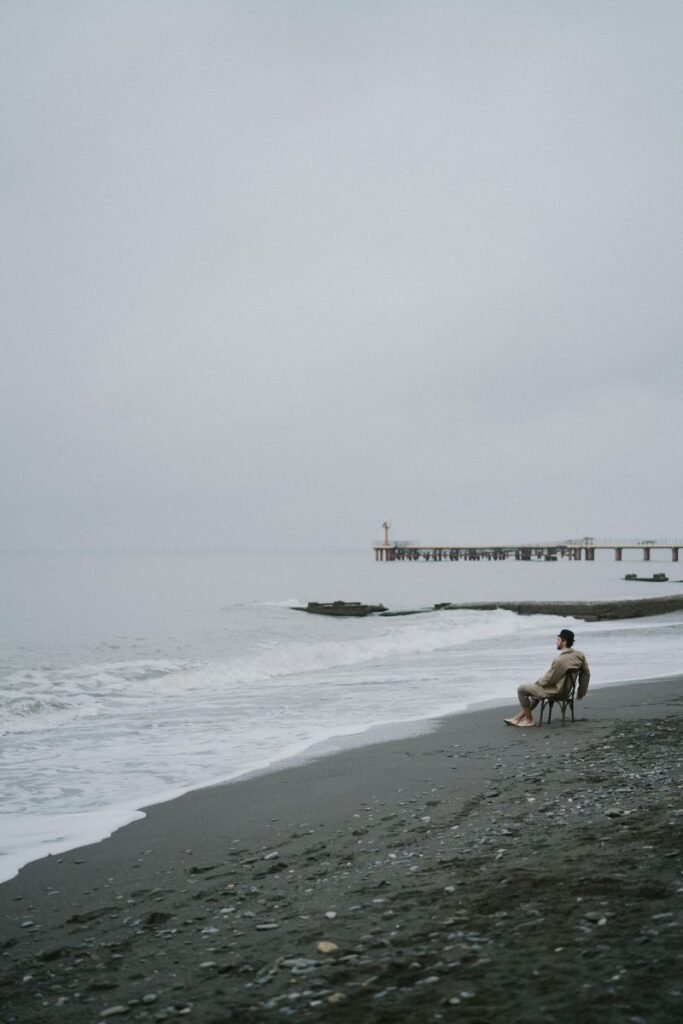
A few years ago, I met a man in Bali.
He was 45. Lean, sun-browned, financially comfortable. A remote worker before it became aspirational branding. The type of person who embodied what I later described in Childfree Digital Nomadism: Your Guide to Ultimate Freedom — geographic flexibility, financial control, intentional living.
He surfed at sunrise. Worked remotely in the afternoon. Drifted between countries without logistical anchors.
Over beers one evening, someone asked the question that always circles childfree spaces:
“Any regrets?”
He laughed instinctively. Then he didn’t.
“I never wanted kids,” he said. “I was always clear about that.”
A pause.
“But lately… I think I would’ve liked a daughter.”
Not a family unit.
Neither diapers.
Nor PTA meetings.
A daughter.
He described it abstractly — teaching her to ride a scooter, having long conversations at sixteen, walking her down an aisle someday.
Then he shrugged.
“It’s not enough to blow up my life over,” he said. “But yeah. Sometimes I feel it.”
What struck me wasn’t devastation.
It was specificity.
The Psychology of the “What If”
When regret surfaces in childfree adults, it rarely resembles the horror story people predict.
It’s not existential collapse.
It’s counterfactual thinking.
Human beings are wired to imagine alternative timelines.
If you become a parent, you may imagine:
- The uninterrupted career you didn’t pursue
- The freedom you surrendered
- The identity you reshaped
If you remain childfree, you may imagine:
- The relationship you never formed
- The lineage that ends with you
- The adult child you’ll never meet
You cannot live both lives.
Psychologist Erik Erikson described midlife as the stage of “generativity vs. stagnation” — the desire to contribute beyond oneself. Parenthood is one expression of generativity. It is not the only one.
Mentorship.
Creative work.
Business building.
Community leadership.
Philanthropy.
The Bali nomad didn’t want school runs.
He wanted relational continuity.
That distinction is rarely discussed — but it changes the emotional framing entirely.
The Scale Problem
The cultural script treats regret like a tidal wave waiting offshore.
The research shows something closer to a ripple.
The majority of intentionally childfree adults remain secure in their decision across decades. A small minority experience occasional longing or curiosity. But occasional curiosity is not the same as catastrophic misalignment.
This is where maturity matters.
Regret can exist without dominating.
Parents experience this too — a reality often shielded from open conversation. The difference is framing, not frequency.
Permanence and the Weight of Time
One reason childfree regret feels amplified is biology. Fertility has a timeline. When possibility closes, reflection intensifies.
But reflection is not reversal.
Many adults — especially in their 40s and 50s — go through an identity audit phase. Priorities shift. Mortality becomes more concrete. That shift isn’t exclusive to parenthood decisions. It happens with careers, marriages, relocations, ambitions.
It’s part of developmental psychology.
The presence of reflection does not imply the presence of mistake.
Regret Is a Human Tax, Not a Childfree One

Every meaningful choice eliminates another life path.
When you marry one person, you quietly close the door on every other possible love story. Moving countries means letting go of the life you might have built elsewhere. Choosing to have children reshapes your autonomy in permanent ways. Choosing not to have them means stepping away from a particular generational experience.
Regret is not evidence of wrongness.
It is evidence of depth.
The man in Bali did not sound shattered. He sounded reflective. Grounded. Honest.
He loved his life.
He sometimes wondered about a daughter.
Both truths coexisted.
The Mature Position
A simplistic narrative says:
“No childfree person ever regrets it.”
That isn’t honest.
Another simplistic narrative says:
“You’ll regret it eventually.”
That isn’t supported.
The mature position holds complexity:
- Most intentionally childfree adults do not regret their choice.
- A small minority experience moments of longing.
- Those moments do not automatically translate into life dissatisfaction.
Choosing to be childfree is not about promising permanent emotional flatness.
It is about alignment.
If, at 45 or 60, a flicker appears — it does not retroactively invalidate decades of coherence. And if it never appears — that does not make you cold or incomplete.
The data tells us regret is not the dominant outcome.
The human stories tell us complexity exists.
Holding both without fear — that is adulthood.
And that is freedom.